


Landscape Lighting influences how people experience a city after sunset. It supports pedestrian safety, highlights architecture, strengthens the character of public spaces and helps create an attractive nighttime environment.
A successful Urban Landscape Lighting project should balance function, visual identity, energy efficiency and long-term maintenance. Selecting attractive luminaires is only one part of the process. Lighting levels, fixture positions, optical distribution, color temperature, glare, controls and surrounding architecture must also be coordinated.
The following factors can help municipalities, developers, landscape architects and lighting designers plan more effective lighting for plazas, commercial streets, parks, waterfronts and pedestrian areas.
1. Define the Purpose of the Lighting
Different public spaces require different lighting priorities. A pedestrian pathway needs comfortable and continuous illumination, while a civic square may also require decorative focal points, event lighting and architectural accents.
Before selecting products, define the main objectives of the project:
Support safe pedestrian movement
Improve recognition of steps, kerbs and level changes
Highlight entrances and gathering areas
Strengthen the architectural identity of the site
Improve nighttime orientation and wayfinding
Illuminate trees, sculptures or landscape features
Create an attractive commercial or cultural atmosphere
Support public events and seasonal activities
Reduce unnecessary energy consumption
Limit glare and light spill
A project may have several objectives, but their priority should be clear. Functional lighting should normally be established before decorative effects are added.
2. Divide the Site into Lighting Zones
Large public spaces should be divided into functional zones. Each zone can then be evaluated according to its users, activity level and required visual effect.
Site Zone | Main Lighting Purpose | Important Considerations |
Pedestrian pathways | Provide continuous guidance and visibility | Uniformity, glare control and recognition of surface changes |
Plazas and gathering areas | Support social activity, orientation and events | Flexible lighting levels and balanced coverage |
Commercial streets | Improve visibility and create an attractive nighttime atmosphere | Coordination with shopfronts, signs and pedestrian movement |
Building entrances | Identify access points and improve security | Facial visibility, vertical illumination and transition between spaces |
Landscape features | Highlight trees, sculptures, fountains and planting | Beam control, equipment concealment and maintenance access |
Waterfront areas | Support safe movement while protecting the nighttime environment | Reflections, corrosion resistance and light spill toward water |
Steps and ramps | Improve recognition of height changes and edges | Low glare, shadow control and continuous coverage |
Zone planning helps prevent one lighting level or one luminaire type from being applied to the entire site. It also allows different operating schedules to be assigned to different areas.
3. Build the Lighting in Layers
Effective Landscape Lighting usually combines several lighting layers rather than relying on one type of fixture.
A typical layered design may include:
General lighting for overall visibility
Pathway lighting for pedestrian guidance
Vertical lighting for faces, signs and entrances
Accent lighting for trees, sculptures and architectural details
Decorative Lighting for identity and visual interest
Integrated information or display functions where required
Lighting Layer | Possible Product Type | Primary Function |
General illumination | Landscape light poles or area luminaires | Provide broad coverage for public spaces |
Pedestrian lighting | Low-height poles, Garden Lights or bollards | Guide walking routes and identify edges |
Vertical illumination | Asymmetric luminaires or controlled floodlights | Improve recognition of people, signs and entrances |
Architectural accents | Wall washers, projectors or linear luminaires | Reveal building form, texture and details |
Landscape accents | Focused spotlights or concealed luminaires | Highlight planting, trees, sculptures and water features |
Decorative focal points | Light columns or sculptural lighting structures | Create identity and visual landmarks |
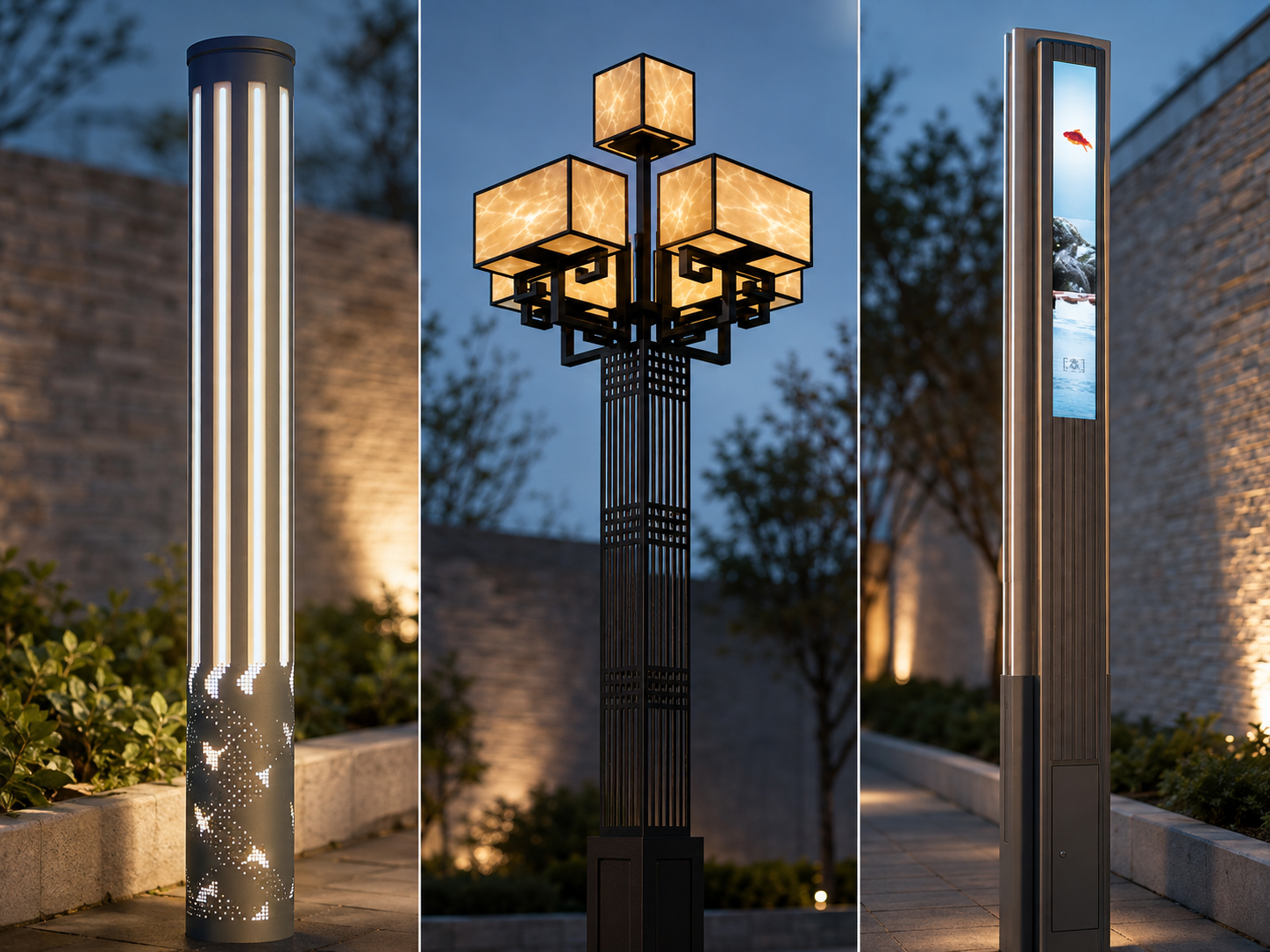
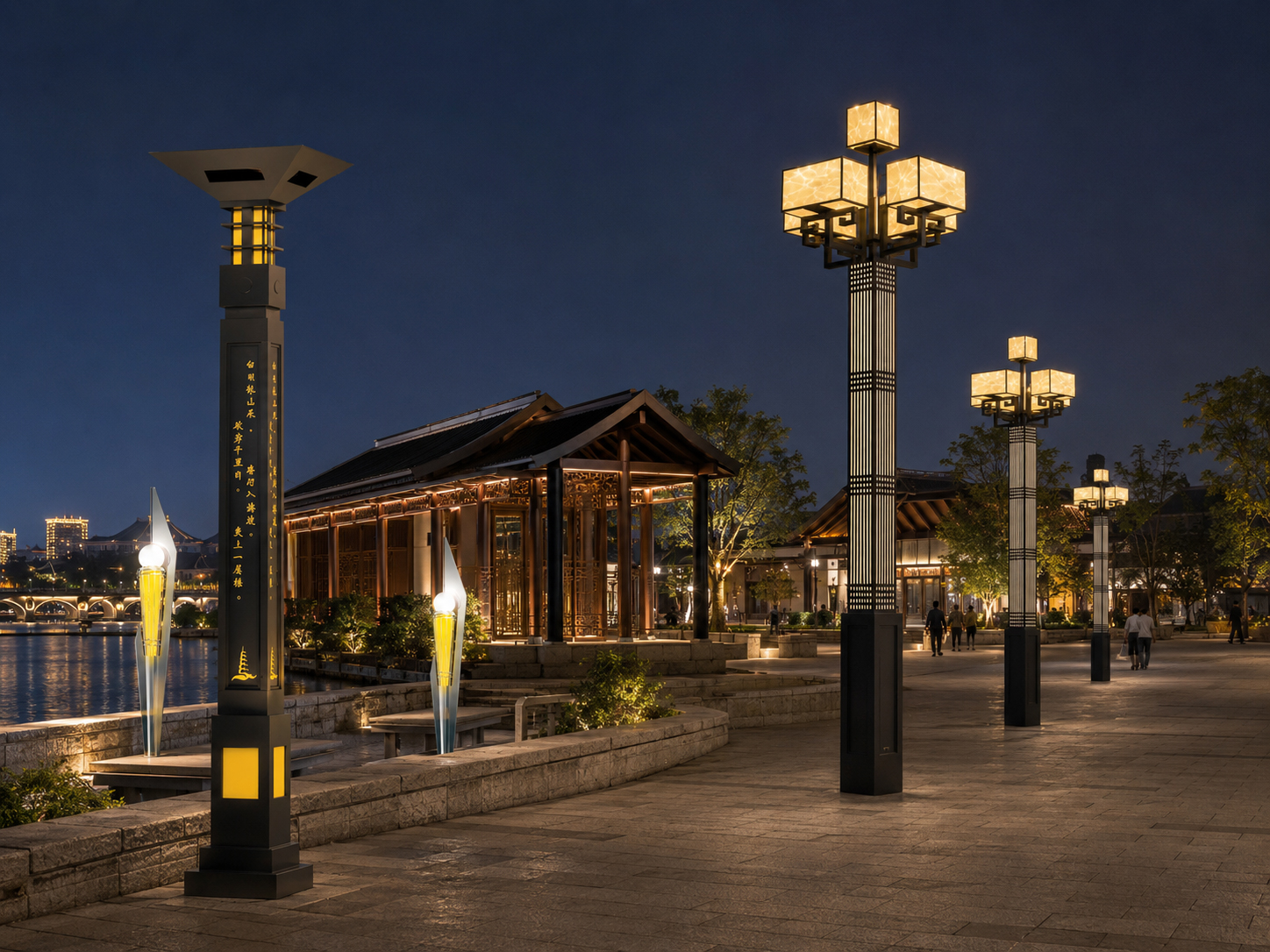
Modern Landscape Lighting can combine clean architectural forms, efficient LED light sources and project-specific optical configurations. Some projects may also integrate information panels, illuminated graphics or customized decorative elements into the lighting structure.
The layers should support one another. Excessive accent lighting can compete with functional illumination, while insufficient general lighting may create uncomfortable contrast between bright focal points and dark surroundings.
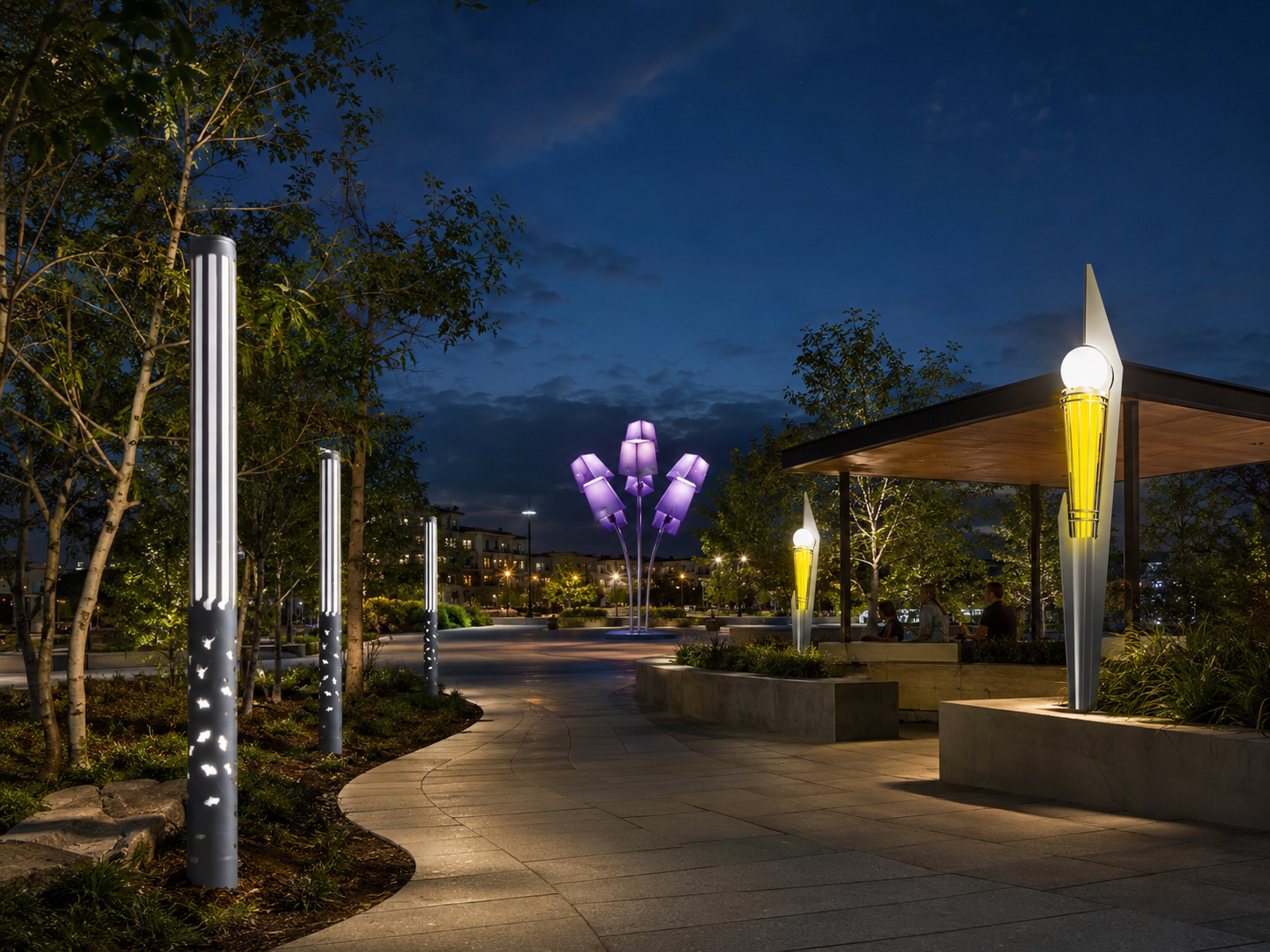
4. Select Products According to the Space
Product selection should reflect the scale, function and architectural character of each area.
4.1 Landscape Light Columns
Landscape light columns can provide both illumination and a strong daytime architectural presence. They are suitable for plazas, commercial streets, civic areas and major pedestrian spaces.
4.2 Garden and Pathway Lights
Lower-height garden lights can provide more comfortable pedestrian-scale illumination. They are suitable for pathways, residential landscapes, courtyards and park areas.
4.3 Bollard Lights
Bollards can mark pathway edges and provide low-level guidance. Their optical design should minimize direct glare because the light source is positioned close to the viewer’s normal field of vision.
4.4 Wall Washers and Linear Lights
Wall washers and linear luminaires can reveal architectural surfaces and landscape structures. The mounting distance and beam distribution should be coordinated with the height, texture and reflectance of the illuminated surface.
4.5 Floodlights and Accent Lights
Controlled floodlights and projectors can highlight trees, sculptures, façades and water features. Narrow, medium or wide distributions should be selected according to the object size and mounting distance.
4.6 Artistic and Sculptural Lights
Artistic luminaires can function as illuminated landmarks. Their appearance during the day should be considered as carefully as their nighttime effect.
5. Coordinate Decorative Design with the Surroundings
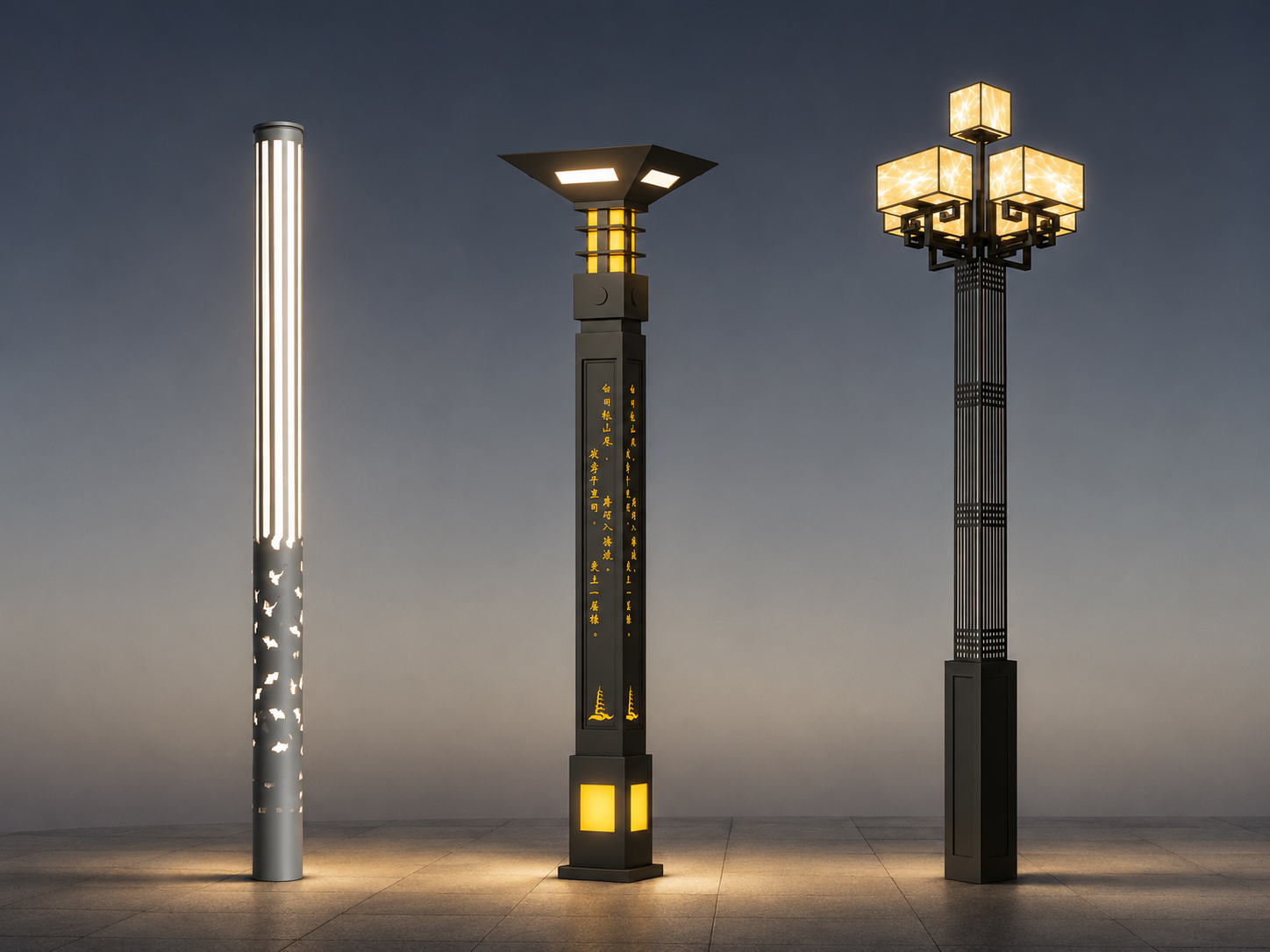
Landscape lighting is visible during both day and night. Pole proportions, materials, colors and decorative elements should therefore coordinate with the surrounding architecture and public-space design.
Decorative Landscape Lighting may incorporate cultural patterns, lantern forms, illuminated panels, customized graphics or sculptural elements. These features can help communicate the identity of a city, district or development.
Decorative design should consider:
Local architectural style
Cultural and historical context
Street furniture and landscape materials
Building colors and façade details
Scale of the surrounding space
Daytime appearance
Nighttime brightness and color
Ease of cleaning and maintenance
Resistance to weather and vandalism
Decoration should not interfere with the optical performance, structural safety or maintenance access of the luminaire. Large panels and ornaments should also be included in the wind-load calculation.
6. Set Appropriate Lighting Levels
More light does not automatically create a safer or more attractive public space. Excessive brightness can increase glare, waste energy and reduce the visibility of surrounding areas.
The required lighting performance depends on:
Type of public space
Pedestrian activity
Vehicle interaction
Security requirements
Surface reflectance
Background brightness
Operating period
Applicable local standard
Important design criteria may include average illuminance, minimum illuminance, uniformity, vertical illumination and glare.
Areas with steps, ramps, intersections or mixed pedestrian and vehicle movement may require separate evaluation. Lighting levels should be selected according to the actual visual task rather than using one value for the entire project.
7. Prioritize Uniformity and Visual Adaptation
Uniformity affects visual comfort and the ability to identify obstacles. A pathway with bright pools of light separated by dark sections can be more difficult to use than a pathway with a lower but more consistent lighting level.
Uniformity can be improved by coordinating:
Luminaire spacing
Mounting height
Optical distribution
Luminaire orientation
Surface reflectance
Tree positions and seasonal foliage
Output of adjacent fixtures
The transition between areas is also important. People may need time to adapt when moving from a brightly illuminated commercial street into a quieter park or waterfront area.
Lighting zones should therefore be connected through gradual changes in brightness rather than abrupt contrast wherever practical.
8. Control Glare
Glare can reduce visibility and make public spaces uncomfortable. It is particularly important in pedestrian areas because luminaires are often installed at relatively low mounting heights.
Glare control may involve:
Using suitable lenses, shields or louvers
Keeping bright LED sources outside normal viewing angles
Selecting an appropriate mounting height
Aiming projectors carefully
Reducing excessive contrast
Avoiding uncontrolled upward light
Using lower output where high output is unnecessary
Bollards, in-ground lights and upward-facing projectors require particular attention because they can direct light toward pedestrians if they are positioned or aimed incorrectly.
A site inspection or nighttime mock-up can help identify glare problems that may not be obvious from product photographs.
9. Choose a Suitable Color Temperature
Color temperature influences atmosphere, visual comfort and the appearance of materials and vegetation.
Color Temperature | Typical Visual Effect | Possible Applications |
Approximately 2700K–3000K | Warm and comfortable appearance | Historic areas, courtyards, parks, restaurants and residential landscapes |
Approximately 3500K–4000K | Neutral and balanced appearance | Urban plazas, commercial streets and mixed public spaces |
Approximately 5000K or above | Cooler and visually crisp appearance | Selected functional areas where specifically required |
A higher color temperature is not automatically more efficient or suitable. Many urban projects prefer warm or neutral-white light because it creates a more comfortable pedestrian environment and reduces excessive blue-rich light.
Different color temperatures should be mixed only when they support a clear design purpose. Unplanned mixing can make a project appear visually inconsistent.
10. Evaluate Color Rendering
Color rendering affects how people, plants, paving materials, artwork and architectural surfaces appear at night.
Higher color-rendering performance may be important for:
Commercial streets
Public plazas
Building entrances
Art and sculpture lighting
Cultural districts
Restaurants and hospitality areas
Public spaces with strong material or planting colors
Functional pathways may not require the same color-rendering level as an architectural façade or public artwork. Product selection should therefore reflect the visual importance of each zone.
The appearance of specific materials can be checked using samples or a nighttime lighting mock-up before the final order is confirmed.
11. Coordinate Pole Height Spacing and Optics
Mounting height and spacing affect coverage, uniformity, glare and the visual scale of the space.
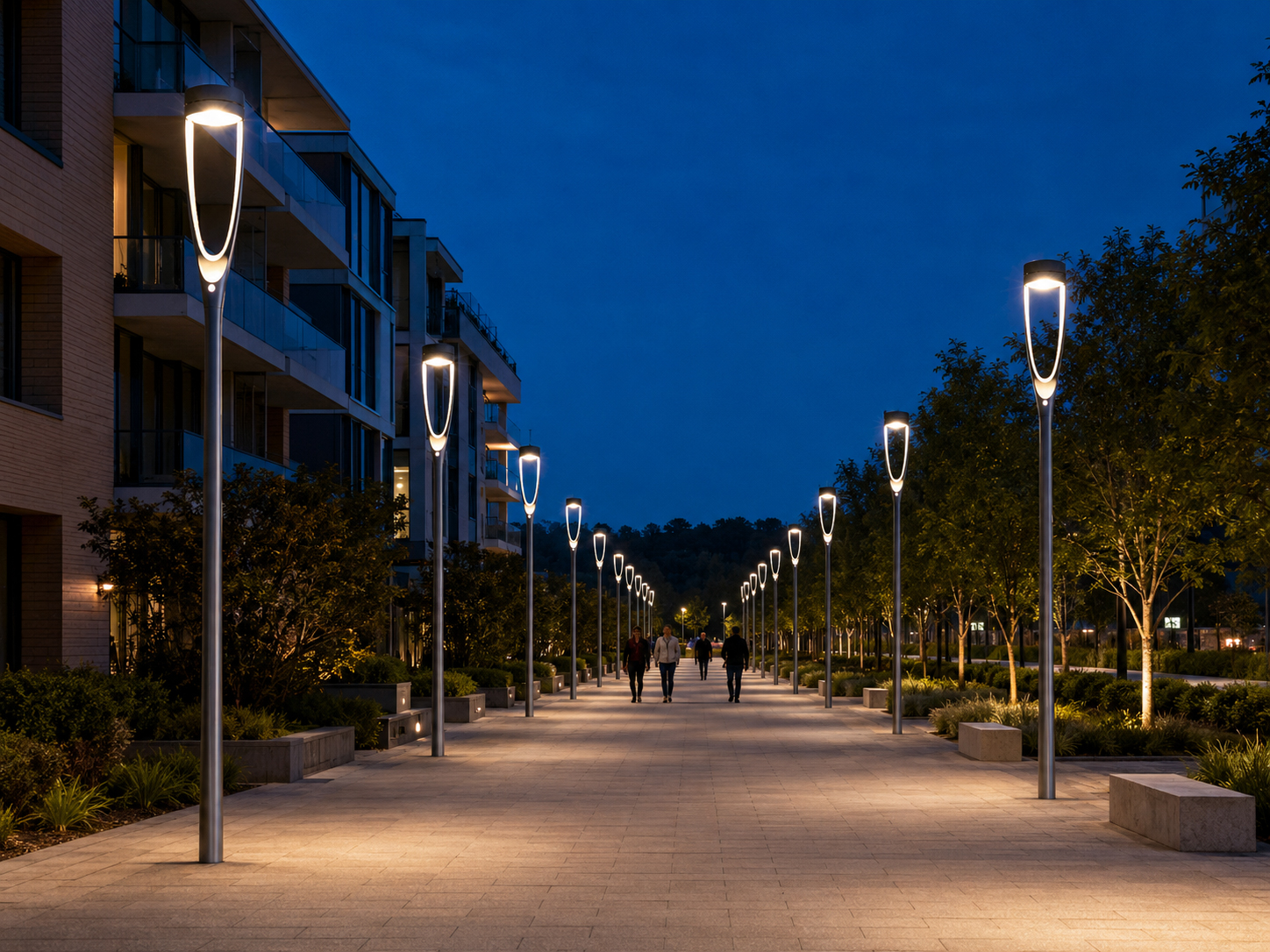
Lower poles create a pedestrian-scale appearance but may require closer spacing. Taller poles can cover larger areas but may appear unsuitable in small courtyards or intimate landscape spaces.
When planning the pole arrangement, consider:
Width of the pathway or plaza
Required lighting level
Optical distribution of the luminaire
Height of nearby buildings and trees
Location of benches and street furniture
Underground utilities
Maintenance vehicle access
Daytime visual rhythm
The pole layout should be coordinated with the landscape plan. Trees planted directly in front of luminaires may block light as they grow, while roots may conflict with foundations and underground cables.
Final spacing should be confirmed through project-specific lighting calculations rather than applying a fixed spacing ratio to every site.
12. Check Outdoor Protection and Structural Reliability
Landscape lighting products operate outdoors and may be exposed to rain, dust, humidity, temperature changes, accidental impact and public contact.
Important specifications include:
Ingress protection of the luminaire and electrical compartments
Impact resistance where the product is accessible to the public
Corrosion-resistant materials and surface treatment
UV-resistant lenses, seals and decorative components
Heat dissipation around LED modules and drivers
Surge and lightning protection
Operating-temperature range
Wind resistance of poles and decorative structures
Foundation and anchor-bolt design
Coastal areas may require additional corrosion protection because of salt exposure. Public spaces with high pedestrian activity may also require stronger impact protection and anti-tamper fasteners.
Decorative panels, illuminated signs and large sculptural components increase the wind-exposed area. The complete installed structure should therefore be included in the structural calculation.
13. Use Controls to Match Actual Activity
Public-space activity often changes throughout the night. Lighting controls can reduce energy consumption while maintaining suitable illumination during occupied periods.
Possible control options include:
Photocell-based automatic switching
Astronomical time control
Time-based dimming
0–10V or 1–10V dimming
DALI control
Centralized lighting management
Motion-responsive lighting in low-traffic zones
Scene control for events and seasonal displays
A typical project may operate at full planned output during busy evening periods and reduce selected lighting layers after pedestrian activity decreases.
Decorative accent lighting may follow a shorter schedule than essential pathway and security lighting. Different circuits or control groups should be planned during the electrical design stage.
Motion-responsive operation may be suitable for quiet pathways and secondary areas, but sudden or excessive changes in brightness should be avoided.
14. Reduce Light Spill and Environmental Impact
Uncontrolled light can affect nearby homes, wildlife, water areas and views of the night sky.
Light spill can be reduced by:
Using precise optical distributions
Aiming luminaires only at the required surfaces
Adding shields or louvers
Avoiding unnecessary upward light
Reducing output during low-activity periods
Selecting suitable color temperatures
Limiting illumination outside the project boundary
Tree and planting illumination should be designed carefully because plant growth and seasonal changes can alter the lighting effect. Equipment should not damage roots, restrict growth or create unnecessary maintenance problems.
Waterfront projects should consider reflections and avoid directing excessive light toward the water surface unless it is required for a specific visual effect.
15. Plan Electrical Infrastructure and Maintenance Access
A reliable landscape lighting system depends on more than the visible luminaires. Underground cables, conduits, junction boxes, foundations, drainage and control cabinets must also be coordinated.
The electrical and civil design should consider:
Power-supply location
Voltage and frequency
Cable routes and voltage drop
Underground conduit arrangement
Waterproof connections
Earthing and bonding
Surge protection
Control groups and circuits
Drainage around in-ground equipment
Access for future cable replacement
In-ground luminaires and low-level fixtures require particular attention to drainage. A product with a suitable protection rating can still fail if water is allowed to remain around the housing or cable connection.
Drivers, control devices and replaceable components should be positioned where technicians can reach them without damaging planting or closing large areas of the site.
16. Request Lighting Calculations and Mock-Ups
Lighting calculations help confirm the functional performance of pathways, plazas and other activity areas before products are ordered.
A DIALux or equivalent calculation can evaluate:
Average illuminance
Minimum illuminance
Uniformity
Pole spacing
Fixture quantity
Light distribution
Estimated power consumption
Light spill around the project boundary
Decorative and architectural effects cannot always be evaluated completely through numerical calculations. A sample installation or nighttime mock-up may therefore be useful for confirming:
Fixture appearance
Glare
Color temperature
Surface brightness
Beam direction
Shadow patterns
Interaction between lighting layers
The simulation and mock-up should use the actual proposed products rather than generic photometric data wherever possible.
17. Avoid Common Landscape Lighting Mistakes
17.1 Selecting Products by Appearance Alone
An attractive daytime design may still provide unsuitable optical performance, glare control or maintenance access.
17.2 Using the Same Lighting Level Everywhere
Different zones have different visual tasks and activity levels. Applying one lighting level can create unnecessary brightness or insufficient visibility.
17.3 Creating Excessive Contrast
Very bright focal points surrounded by dark areas can reduce visual comfort and make navigation more difficult.
17.4 Ignoring Tree Growth
Young trees may not block light during installation but can significantly affect coverage as their branches and leaves develop.
17.5 Mixing Color Temperatures Without a Plan
Uncoordinated color temperatures can make the nighttime environment appear inconsistent.
17.6 Overusing Decorative Effects
Too many colors, patterns or animated effects can compete with the architecture and reduce the visual identity of important focal points.
17.7 Ignoring Maintenance Access
Fixtures positioned inside dense planting, above water or in inaccessible structures may become expensive to inspect and replace.
17.8 Treating All Outdoor Areas as Identical
Coastal, residential, commercial and high-traffic public spaces require different protection, control and maintenance strategies.
18. Information to Send to the Manufacturer
Complete project information allows the manufacturer to recommend more suitable products and prepare an accurate quotation.
The project enquiry should include:
Site plan and landscape drawings
Project country and city
Dimensions of pathways, plazas and activity areas
Required lighting levels or applicable standards
Preferred luminaire types
Proposed pole heights and positions
Preferred architectural style
Color and surface-treatment requirements
Preferred color temperature
Control and dimming requirements
Input voltage and frequency
Local wind, temperature and weather conditions
Coastal or industrial environmental conditions
Required certifications
Estimated project quantity
Reference images can help communicate the preferred style, but the final product configuration should be adjusted according to the project dimensions, lighting requirements and structural conditions.
Conclusion
Planning landscape lighting for urban public spaces requires a balance between visibility, comfort, visual identity, energy efficiency and environmental responsibility.
Functional lighting, decorative structures, architectural accents, color temperature, glare control, smart controls and maintenance access should be designed as one coordinated system. Lighting calculations and nighttime mock-ups can help confirm both technical performance and the intended visual effect.
Baode Lighting provides customized landscape light columns, garden lights, artistic lighting structures, wall washers, floodlights and project-based lighting support. Product styles, pole dimensions, optical configurations, surface treatments and control options can be developed according to the architecture and functional requirements of each project.
Customers can provide site plans, landscape drawings, reference images and technical requirements to receive a project-specific lighting recommendation.
FAQ
1. What types of luminaires are used in urban landscape lighting?
Common products include landscape light columns, garden lights, bollards, wall washers, floodlights, linear luminaires, in-ground lights and artistic lighting structures.
2. What color temperature is suitable for public landscape lighting?
Warm-white light around 2700K–3000K is often suitable for parks, courtyards and historic areas, while neutral-white light around 3500K–4000K may be used for urban plazas and commercial spaces. The final choice should match the project atmosphere and local requirements.
3. How can glare be reduced in pedestrian areas?
Glare can be reduced through suitable mounting heights, shielded optics, careful aiming, lower output and appropriate spacing.
4. Is higher brightness better for public spaces?
No. Excessive brightness can increase glare, energy consumption and contrast. Lighting levels should match the visual requirements of each zone.
5. Why is lighting uniformity important?
Uniformity helps pedestrians identify obstacles and move comfortably without repeatedly adapting between bright and dark areas.
6. Can Decorative Light Columns be customized?
Yes. Pole shapes, colors, illuminated panels, cultural patterns, decorative elements and optical configurations can be customized according to the project design.
7. Is lighting simulation required for landscape projects?
Lighting simulation is useful for verifying functional areas such as pathways and plazas. Decorative effects may also require a physical mock-up or sample installation.
8. Can landscape lighting use intelligent controls?
Yes. Time-based dimming, DALI control, centralized management, motion sensing and scene control can be configured according to the project requirements.


Komentar
(0)